

- Abstract
- Video Abstract
- Keywords
- Introduction
- Materials and methods
- Results
- Discussion
- Conclusions
- Abbreviations
- Author contributions
- Publication history
- AI disclosure
- Funding
- Trial registration
- Ethics statement
- Consent to publication
- Data availability
- Acknowledgements
- Conflicts of interest
- Copyright
- Publisher's note
- References
Beyond the prescription: self-management practices and their sociodemographic determinants among type 2 diabetes patients visiting physicians
Published: 23 March 2026
Volume 5
Abstract
The prevalence of type 2 diabetes mellitus (T2DM) is rising steeply across South Asia, and day-to-day self-management largely determines whether patients avoid complications. However, local evidence on which patients struggle most remains limited. This exploratory study examined the pattern and determinants of self-management among adults with T2DM visiting physicians in Sargodha, Punjab, Pakistan. Between July and August 2025, 483 eligible patients were recruited by consecutive sampling across five outpatient clinics and hospital-linked pharmacies. A structured, interviewer-administered questionnaire adapted from a previously published regional instrument captured nine recommended self-care practices and sociodemographic and clinical characteristics; each interview lasted approximately ten minutes. The proportion of patients reporting each practice was summarized with Wilson confidence intervals (CIs), and a practice-count index (0–9) was derived. Because the internal consistency of the nine items was low (Kuder–Richardson 20 = −0.11; mean interitem φ = 0.08; Kaiser–Meyer–Olkin [KMO] = 0.56), practices were analyzed individually, and adequate self-management was defined a priori as adherence to at least five of nine practices. Associations were tested using chi-square tests, t tests and multivariable binary logistic regression, with Poisson regression as a sensitivity analysis. Adherence was highest for home and periodic blood glucose monitoring (68.1% and 67.3%, respectively) and lowest for three-monthly glycated hemoglobin (HbA1c) testing (26.5%) and stress-management techniques (45.5%). Overall, 70.8% achieved adequate self-management. In the adjusted analysis, younger age (adjusted odds ratio [aOR] 0.96 per year; 95% CI 0.94–0.98) and being married rather than unmarried (unmarried aOR 0.37; 95% CI 0.20–0.67) independently predicted adequate self-management (likelihood ratio χ² = 28.8, p = 0.001; area under the curve 0.66). Education, income, family system, disease duration, family history and smoking status were not independent predictors. Diabetes self-care in this setting is uneven, with striking underuse of laboratory monitoring and stress management. Older and unmarried patients warrant targeted support.
Video Abstract
Beyond the prescription: self-management practices and their sociodemographic determinants among type 2 diabetes patients visiting physicians
by Ayesha Tahir et al.
Keywords
Diabetes mellitus, type 2; Glycated hemoglobin; Pakistan; Primary health care; Self care; Self-management; Sociodemographic factors
1. Introduction
Diabetes mellitus has become one of the defining chronic disease challenges of the present era. Global estimates indicate that approximately 537 million adults were living with diabetes in 2021, a figure projected to reach 783 million by 2045, with the sharpest increases concentrated in low- and middle-income countries [1]. Pakistan now has one of the heaviest burdens in the world, ranking among the top three countries in terms of the absolute number of affected adults, and type 2 diabetes mellitus (T2DM) accounts for the overwhelming majority of these cases [1,2]. The World Health Organization (WHO) continues to identify diabetes as a leading driver of blindness, kidney failure, myocardial infarction, stroke and lower-limb amputation, most of which are preventable when the disease is well controlled [2].
Unlike acute illness, T2DM is managed largely by the patient rather than the clinician. The everyday behaviors that determine outcomes—taking medicines as prescribed, following an appropriate diet, being physically active, monitoring blood glucose, examining the feet, attending laboratory tests and coping with psychological strain—unfold at home and between clinic visits and are strongly shaped by the social and economic conditions in which patients live [3,4,5,6]. These behaviors, collectively termed diabetes self-management, are the practical expression of the recommendations set out in contemporary standards of care and in national standards for diabetes self-management education and support [5,6]. Their importance is not merely theoretical: structured self-monitoring of blood glucose, regular physical activity and systematic foot care each has a demonstrable effect on glycemic control and on the risk of complications [7,8,9].
Where patients obtain their medicines and advice also matters. In much of South Asia, care is fragmented across physicians in outpatient clinics and pharmacists in community and hospital-linked settings, and a growing body of trial evidence shows that interventions delivered by either professional group can improve glycemic control, blood pressure and medication adherence [10,11,12,13,14]. An earlier exploratory study from Lahore compared self-management among patients who were attending physicians with those who were attending pharmacists and reported meaningful gaps in several practices, most notably laboratory monitoring [15]. That work supplied the questionnaire and conceptual starting point for the present study, but it did not model patient-level factors that might explain why some patients manage their condition well and others do not.
Internationally, self-care behavior varies with sociodemographic circumstances. Age, sex, marital status, educational attainment, household income, family structure and disease duration have been linked to self-management in studies from Jordan, Ghana, India, Portugal and elsewhere, although the direction and strength of these associations vary considerably across settings [16,17,18,19]. Psychological factors, particularly diabetes-related distress, further shape whether patients sustain healthy routines [20,21]. In Pakistan specifically, qualitative work suggests that barriers differ by educational level and that structured, patient-centered programs can improve self-efficacy and behavior [22,23]. What is largely missing is a quantitative, determinant-focused analysis of self-management among patients as they actually present for care.
This study was therefore designed with two aims. First, we aimed to describe the proportion of patients reporting each of nine recommended self-management practices among adults with T2DM who visit physicians at outpatient clinics and hospital-linked pharmacies in Sargodha, Punjab, Pakistan. Second, we sought to identify the sociodemographic and clinical characteristics independently associated with adequate self-management. Given the descriptive and hypothesis-generating character of the work, we framed it as an exploratory study and report it in accordance with STROBE recommendations for observational research [24].
2. Materials and methods
2.1. Study design and setting
We conducted an exploratory study over an eight-week period from July to August 2025. Data were collected at five sites in Sargodha, Punjab, Pakistan: outpatient clinics and hospital-linked pharmacies at which people with T2DM commonly present to purchase antidiabetic medicines, to undergo diabetes-related laboratory testing and to consult a physician about their condition. Sites were selected purposively to include settings that had a prescribing physician onsite and that together served patients drawn from a range of socioeconomic backgrounds, so that the sample would reflect the mixed clientele typical of urban and peri-urban diabetes care in the region.
2.2. Sample size
Because the number of people with T2DM attending these sites over the study window could not be determined (no register of patients attending the five sites was available) and was therefore treated as unknown and very large, the sample size was estimated using the Cochran formula for an unknown or very large population, n₀ = Z²p(1−p)/e² [25,26]. With a 95% confidence level (Z = 1.96), an expected proportion of 0.50 and a 5% absolute margin of error (e = 0.05), the minimum required sample size was 384. The most conservative value, p = 0.50, was used because no reliable local estimate of overall adherence was available and the nine practices were expected to vary widely in frequency. To allow for up to 20% incomplete or unusable questionnaires, the recruitment target was inflated to 480 (384/0.8), and 483 complete interviews were obtained. This calculation served the primary, descriptive objective of estimating the proportion of patients reporting each practice. Its adequacy for the secondary, analytical objective was checked separately: with 141 patients in the smaller outcome category and 10 parameters in the multivariable model, there were approximately 14 outcome events per parameter, above the commonly used minimum of 10, although this rule of thumb is only a rough guide [27].
2.3. Sampling and recruitment
Participants were enrolled by consecutive sampling. During prearranged data-collection sessions at each site, every patient presenting for diabetes-related medicines, testing or consultation was screened for eligibility, and all those who met the criteria and consented were interviewed in the order in which they presented until the target across sites was reached. This walk-in, consecutive approach is well suited to the exploratory objective and to the flow of patients through pharmacy and clinic settings; its nonprobability nature is acknowledged among the study limitations.
2.4. Eligibility criteria
Adults aged 18 years or older with a physician-confirmed diagnosis of T2DM of at least two years' duration who were attending one of the five study sites in person during the study period and who were willing to provide written informed consent were eligible. Patients with type 1 or gestational diabetes, those newly diagnosed (less than two years), pregnant women and individuals with a psychiatric or cognitive condition that precluded a reliable interview were excluded. These criteria are consistent with those of the source study and with the observed data, in which all participants were adults and reported a disease duration of two years or more [15].
2.5. Questionnaire development
The instrument was adapted from the previously published regional questionnaire used by Malik and colleagues, which was informed by established self-care measures [15]. It comprised two sections. The first recorded sociodemographic and clinical characteristics: sex, age, marital status, years of formal education, monthly household income, family system, duration of T2DM and family history of diabetes. The second captured self-management using ten dichotomous (yes/no) items: cigarette smoking (a risk behavior) and nine recommended practices, namely daily feet checking, daily medication use, exercising for at least 20–30 minutes on at least five days per week, eating a well-balanced planned diet, checking random blood glucose at least once every three months, checking home blood sugars according to physician advice, checking glycated hemoglobin (HbA1c) every three months, using stress-management techniques, and regular random blood pressure monitoring. The content was reviewed by a physician and a pharmacist for clarity and local relevance, the instrument was translated into Urdu and back-translated to confirm fidelity, and it was pretested on a small group of patients who were not included in the final sample. Minor wording revisions followed the pilot test.
2.6. Data collection
Trained interviewers administered the questionnaire face-to-face in a private area at each site. Each interview lasted approximately ten minutes and was conducted separately from any clinical or dispensing encounter so that the responses were not influenced by the consultation itself. Interviewers recorded responses directly, and completed forms were checked for completeness on the same day, which is reflected in the absence of missing values in the final dataset.
2.7. Variables and outcome definition
The nine recommended practices were analyzed both individually and as a summed practice-count index ranging from 0 to 9. Because diabetes self-care behaviors are known to be only weakly intercorrelated, we first examined the internal structure of the nine items. Internal consistency was low (Kuder–Richardson 20 = −0.11), the mean absolute interitem phi coefficient was 0.08, and the Kaiser–Meyer–Olkin (KMO) measure of sampling adequacy was 0.56, indicating that the items did not form a unidimensional scale. We therefore treated the practices primarily as distinct behaviors and retained the count only as a descriptive summary. For determinant modeling, adequate self-management was defined a priori as adherence to at least five of the nine practices (that is, a majority of recommended behaviors), in line with the common convention of classifying self-care as good when at least half of the maximum possible score is attained [28]; this cutoff also coincided with the median practice count in the sample. Patients below this threshold were classified as having inadequate self-management. Cigarette smoking was treated as an explanatory clinical/behavioral characteristic rather than as a self-care practice.
2.8. Statistical analysis
Continuous variables were summarized as mean and standard deviation or median and interquartile range, and categorical variables were summarized as frequencies and percentages. The proportion of patients reporting each practice was reported with 95% Wilson confidence intervals (CIs). Bivariate associations between patient characteristics and adequate self-management were tested using the chi-square test (with Cramér's V as an effect size) for categorical variables and the independent-samples t test (with Cohen's d) for continuous variables; the Mann–Whitney U test was used as a robustness check for skewed continuous variables. All characteristics were then entered simultaneously into a multivariable binary logistic regression model with adequate self-management as the outcome, and adjusted odds ratios (aORs) with 95% CIs were derived. Model performance was assessed using the likelihood ratio test, the Nagelkerke pseudo-R², the Hosmer–Lemeshow goodness-of-fit test and the area under the receiver operating characteristic curve (AUC). As a sensitivity analysis, a Poisson regression model was fitted to the practice-count index. Given the exploratory design, no adjustments were made for multiple comparisons, and associations were interpreted as hypothesis-generating. A two-sided p value ≤ 0.05 was considered statistically significant. Analyses were performed in Python 3 using the statsmodels (version 0.14) and SciPy (version 1.17) libraries.
2.9. Ethical considerations
The study protocol was reviewed and approved by the Ethical Review Committee, Rai Foundation Medical College (a project of Rai Institute of Medical Sciences), Sargodha, Pakistan (No. RFMC/IRAB/Protocol/No.2025-005). All participants provided written informed consent before enrollment, participation was voluntary, no personally identifying information was recorded, and the data were analyzed in anonymized form. The study conformed to the principles of the Declaration of Helsinki.
3. Results
3.1. Sample characteristics
A total of 483 adults with T2DM completed the interview. Their characteristics are summarized in Table 1. Just under two-thirds were men (64.4%), and the mean age was 44.8 ± 10.5 years, ranging from 18 to 76 years. Most were married (73.3%) and lived within a joint family system (75.2%). Formal education was limited: 42.7% had received no formal schooling, and the mean duration of formal education was 6.5 ± 6.2 years. The median monthly household income was PKR 51,000 (interquartile range 39,500–70,000). The mean duration of diagnosed T2DM was 7.2 ± 2.6 years; almost two-thirds reported a family history of diabetes (63.6%), and 41.0% were current cigarette smokers.
| Characteristic | Value | |
| n (%) | ||
| Sex | Male | 311 (64.4) |
| Female | 172 (35.6) | |
| Age (years), mean ± SD | 44.8 ± 10.5 | |
| Age | 18–39 years | 165 (34.2) |
| 40–49 years | 206 (42.7) | |
| ≥ 50 years | 112 (23.2) | |
| Marital status | Married | 354 (73.3) |
| Unmarried | 101 (20.9) | |
| Widowed/separated/divorced | 28 (5.8) | |
| Education | No formal education | 206 (42.7) |
| 1–10 years | 99 (20.5) | |
| > 10 years | 178 (36.9) | |
| Monthly household income (PKR), median (IQR) | 51,000 (39,500–70,000) | |
| Family system | Joint | 363 (75.2) |
| Nuclear | 120 (24.8) | |
| Duration of type 2 diabetes mellitus (years), mean ± SD | 7.2 ± 2.6 | |
| Family history of diabetes | Yes | 307 (63.6) |
| Cigarette smoking | Yes | 198 (41.0) |
| Abbreviations: SD, standard deviation; IQR, interquartile range; PKR, Pakistani rupees. | ||
3.2. Self-management practices
Adherence to the individual practices is presented in Table 2. Blood glucose monitoring was the most commonly reported behavior: 68.1% of the participants checked home blood sugars in line with physician advice, and 67.3% had a random blood glucose check at least once every three months. A well-balanced planned diet (66.5%), daily medication use (65.8%) and regular exercise (62.3%) were also reported by approximately two-thirds of the patients. Blood pressure monitoring (60.0%) and daily feet checking (58.0%) were somewhat less common. The two conspicuous gaps were the use of stress-management techniques, reported by fewer than half (45.5%), and three-monthly HbA1c testing, reported by only approximately one-quarter of patients (26.5%)—by a wide margin the least-practiced behavior in the cohort.
| Self-Management Practice | Yes, n (%) | 95% CI |
| Checking home blood sugars (per physician advice) | 329 (68.1) | 63.8–72.1 |
| Random blood glucose (≥ once/3 months) | 325 (67.3) | 63.0–71.3 |
| Eating a well-balanced, planned diet | 321 (66.5) | 62.1–70.5 |
| Daily medication use | 318 (65.8) | 61.5–69.9 |
| Exercising ≥ 20–30 min, ≥ 5 days/week | 301 (62.3) | 57.9–66.5 |
| Regular blood pressure monitoring | 290 (60.0) | 55.6–64.3 |
| Daily feet checking | 280 (58.0) | 53.5–62.3 |
| Using stress-management techniques | 220 (45.5) | 41.2–50.0 |
| Checking HbA1c every 3 months | 128 (26.5) | 22.8–30.6 |
| Abbreviation: CI, confidence interval (Wilson method). | ||
3.3. Practice-count index and its internal structure
Patients adhered to a mean of 5.20 ± 1.37 of the nine practices (median 5, interquartile range 4–6); the distribution is shown in Figure 1. Using the prespecified threshold, 342 patients (70.8%) achieved adequate self-management (≥ 5 of 9). Consistent with the broader literature, the nine practices largely behaved as independent behaviors rather than as facets of a single construct: internal consistency was low (Kuder–Richardson 20 = −0.11), the mean absolute interitem correlation was 0.08, and only one pair—daily feet checking and HbA1c testing—showed a moderate association (φ = 0.37; Figure 2). This pattern justified analyzing the practices individually and interpreting the count purely descriptively.
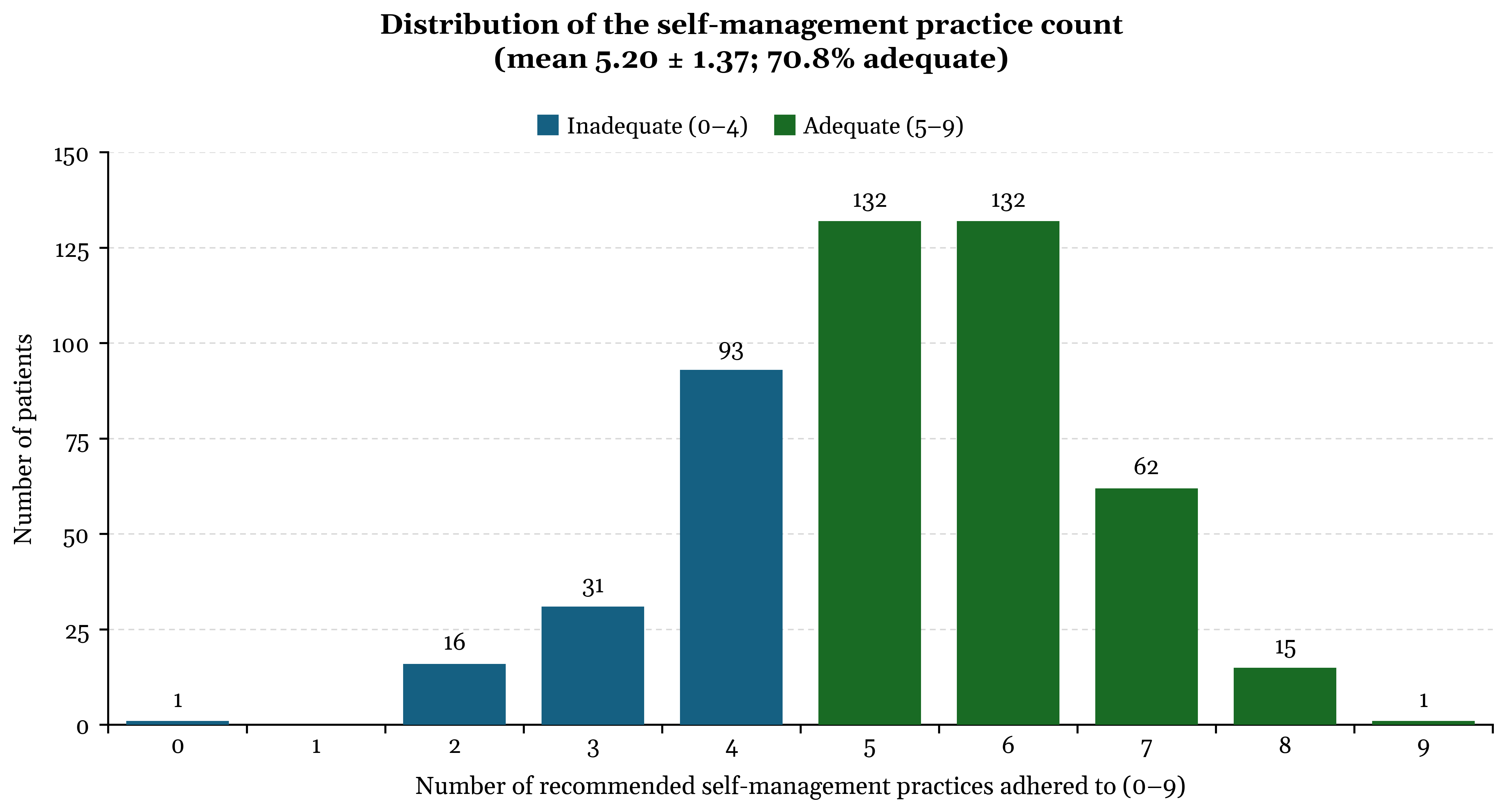
Figure 1. Distribution of the self-management practice-count index (0–9). The bars at or above the prespecified adequacy threshold (≥ 5) are shaded green.
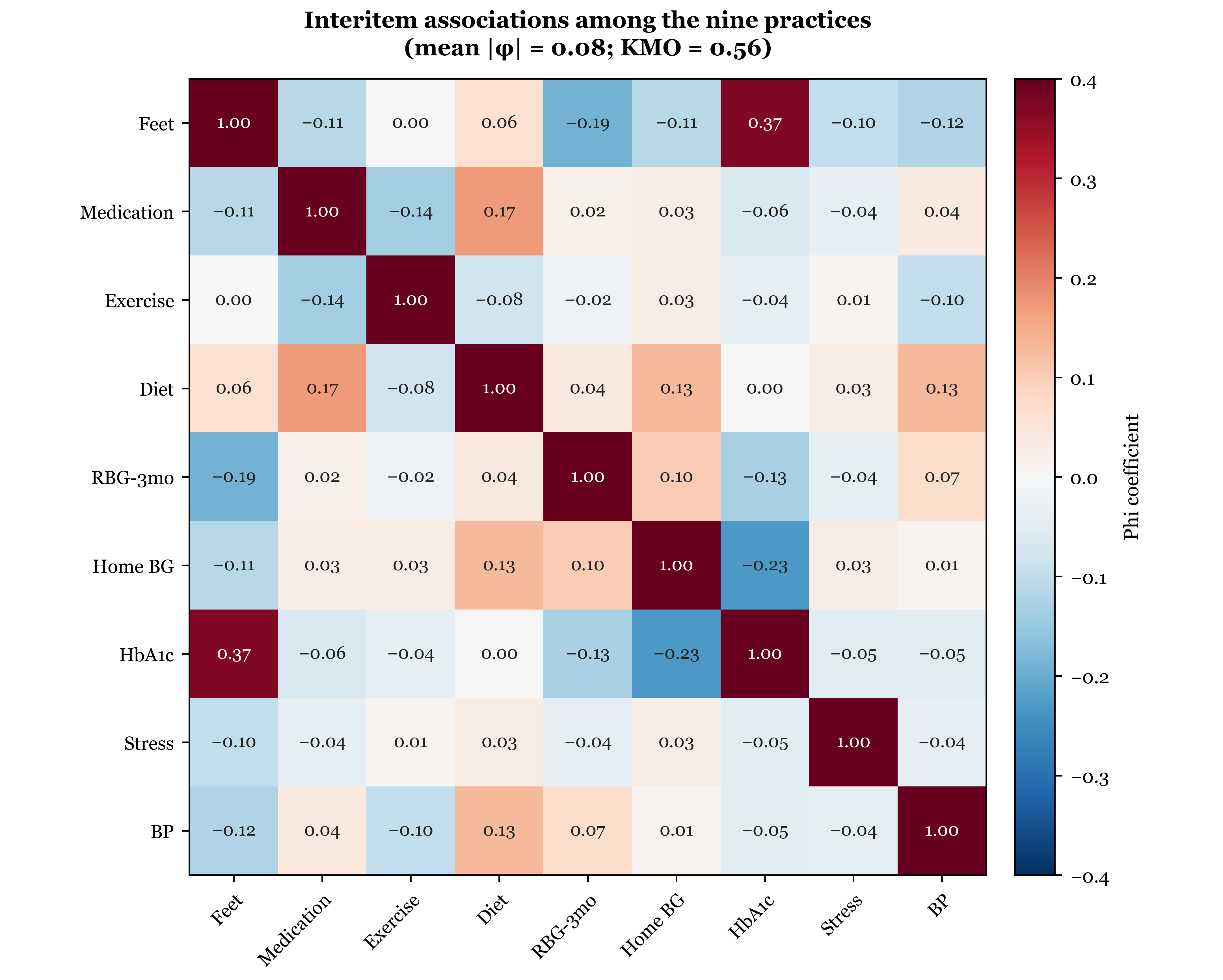
Figure 2. Interitem associations (phi coefficients) among the nine practices. The generally weak associations (mean |φ| = 0.08) and a Kaiser–Meyer–Olkin value of 0.56 indicate that the items do not form a unidimensional scale.
3.4. Factors associated with adequate self-management
Bivariate associations are shown in Table 3. Adequate self-management was significantly related to age, both as a continuous variable (44.0 ± 10.0 years in the adequate group versus 46.7 ± 11.3 years in the inadequate group; p = 0.011) and across age groups, decreasing from 75.2% among those aged 18–39 years to 61.6% among those aged 50 years or older (p = 0.042). It also varied by marital status (p = 0.035): married and widowed/separated/divorced patients were more likely to manage adequately (73.4% and 75.0%, respectively) than unmarried patients were (60.4%). A greater percentage of men than women achieved adequacy (74.0% versus 65.1%), a difference of borderline significance (p = 0.052). Education, income, family system, family history, disease duration and smoking showed no significant bivariate association with adequate self-management. At the level of individual practices, several behaviors differed by patient characteristics—for example, three-monthly random blood glucose checking differed by sex (χ² = 13.6, p < 0.001) and blood pressure monitoring by smoking status (χ² = 11.1, p = 0.001)—but these isolated associations should be read cautiously in light of multiple testing.
| Characteristic | Adequate (n = 342) n (%) |
Inadequate (n = 141) n (%) |
Test (t/ χ²/ Cohen's d) |
p Value | |
| Age (years), mean ± SD | 44.0 ± 10.0 | 46.7 ± 11.3 | d = 0.26, t = 2.56 | 0.011 *** | |
| Age (years) | 18–39 | 124 (75.2) | 41 (24.8) | χ² = 6.32 | 0.042 *** |
| 40–49 | 149 (72.3) | 57 (27.7) | |||
| ≥ 50 | 69 (61.6) | 43 (38.4) | |||
| Sex | Male | 230 (74.0) | 81 (26.0) | χ² = 3.77 | 0.052 |
| Female | 112 (65.1) | 60 (34.9) | |||
| Marital status | Married | 260 (73.4) | 94 (26.6) | χ² = 6.73 | 0.035 *** |
| Unmarried | 61 (60.4) | 40 (39.6) | |||
| Widowed/separated/divorced | 21 (75.0) | 7 (25.0) | |||
| Education | None | 147 (71.4) | 59 (28.6) | χ² = 0.27 | 0.873 |
| 1–10 years | 68 (68.7) | 31 (31.3) | |||
| > 10 years | 127 (71.3) | 51 (28.7) | |||
| Income (PKR), mean ± SD (×10³) | 52.2 ± 17.1 | 52.5 ± 17.9 | t = 0.14 | 0.892 | |
| Family system, nuclear | 89 (74.2) | 31 (25.8) | χ² = 0.67 | 0.413 | |
| Duration (years), mean ± SD | 7.1 ± 2.5 | 7.5 ± 2.9 | t = 1.31 | 0.191 | |
| Family history, yes | 210 (68.4) | 97 (31.6) | χ² = 2.05 | 0.153 | |
| Smoking, yes | 143 (72.2) | 55 (27.8) | χ² = 0.22 | 0.640 | |
| * Percentages for categorical variables are row percentages (proportion adequate versus inadequate within each level). ** abbreviation: d, Cohen's d. *** Statistically significant at p ≤ 0.05. | |||||
In the multivariable logistic regression (Table 4), two factors remained independently associated with adequate self-management. Each additional year of age reduced the odds of adequacy by approximately 4% (aOR 0.96, 95% CI 0.94–0.98; p < 0.001), and unmarried patients had markedly lower odds than married patients did (aOR 0.37, 95% CI 0.20–0.67; p = 0.001). The widowed/separated/divorced group did not differ significantly from the married reference group (aOR 1.87, 95% CI 0.72–4.83). Sex, education, income, disease duration, family system, family history and smoking status were not independent predictors. The model was statistically significant overall (likelihood ratio χ² = 28.8, p = 0.001), showed acceptable calibration (Hosmer–Lemeshow p = 0.086) and modest discrimination (AUC = 0.66), and explained a limited share of the variance (Nagelkerke R² = 0.083). A Poisson sensitivity model fitted to the practice count reproduced the age effect (incidence-rate ratio 0.995 per year, 95% CI 0.991–0.999; p = 0.020), supporting the robustness of the main finding.
| Predictor | aOR | 95% CI | p Value |
| Age (per year) | 0.96 | 0.94–0.98 | < 0.001 *** |
| Male (versus female) | 1.14 | 0.70–1.86 | 0.599 |
| Unmarried (versus married) | 0.37 | 0.20–0.67 | 0.001 *** |
| Widowed/separated/divorced (versus married) | 1.87 | 0.72–4.83 | 0.199 |
| Education (per year) | 0.99 | 0.96–1.02 | 0.554 |
| Income (per 10,000 PKR) | 1.00 | 0.89–1.13 | 0.986 |
| Duration of type 2 diabetes mellitus (per year) | 0.94 | 0.87–1.02 | 0.135 |
| Nuclear family (versus joint) | 1.32 | 0.81–2.16 | 0.266 |
| Family history (yes versus no) | 0.76 | 0.49–1.17 | 0.212 |
| Smoking (yes versus no) | 1.07 | 0.70–1.65 | 0.746 |
| * Abbreviations: aOR, adjusted odds ratio; CI, confidence interval. ** Model: likelihood ratio χ² = 28.8, p = 0.001; Nagelkerke R² = 0.083; Hosmer–Lemeshow p = 0.086; AUC = 0.66. *** Statistically significant at p ≤ 0.05. | |||
4. Discussion
This exploratory study of 483 adults with T2DM who presented to physicians in Sargodha, Punjab, describes a pattern of self-management that is broadly moderate but distinctly uneven. Between three-fifths and two-thirds of patients reported adhering to most recommended behaviors, and 70.8% met our threshold for adequate self-management. Two behaviors, however, stood out for their low uptake: three-monthly HbA1c testing, reported by only 26.5% of patients, and the use of stress-management techniques, reported by 45.5%. Multivariable analysis showed that younger age and being married were the factors independently associated with adequate self-management, whereas the more commonly cited socioeconomic markers of education and income were not.
The proportions observed here align closely with those in the source study from Lahore, which used the same instrument and reported that HbA1c testing was the least-practiced behavior among physician-attending patients, with diet and stress management at levels very similar to ours [15]. This concordance across independent samples lends face validity to the present findings. Compared with pooled regional estimates for South Asia, where blood glucose monitoring, medication use, physical activity, diet and foot care have been reported at approximately 65%, 64%, 53%, 48% and 42%, respectively, our cohort reported somewhat higher adherence to diet and foot care in particular [29]. The persistent shortfall in laboratory-based monitoring is nonetheless consistent with regional evidence and is plausibly driven by the out-of-pocket cost of HbA1c testing, limited laboratory access and incomplete patient understanding of why periodic testing matters [30,31].
The low uptake of HbA1c testing deserves particular emphasis because it is not merely one behavior among nine; it is the objective yardstick by which glycemic control is judged and treatment intensified [32,33]. Its underuse suggests that a substantial proportion of patients are being managed without the very measurement that current standards of care place at the center of monitoring [34]. Structured self-monitoring of blood glucose and periodic laboratory assessments together support timely treatment adjustment and better outcomes, and the gap identified here points to a concrete, addressable target for clinics and hospital-linked pharmacies—for example, opportunistic point-of-care testing or reminder systems at the point of medicine collection [35,36,37].
Equally striking is the modest use of stress-management techniques. Diabetes-related distress and associated psychological strain are increasingly recognized as barriers to sustained self-care, and interventions that address the emotional burden of the disease can improve both distress and glycemic outcomes [38,39]. The fact that fewer than half of our patients engaged in any form of stress management indicates that the psychological dimension of diabetes care remains largely unaddressed in this setting, despite being a low-cost and scalable avenue for support [40].
The independent association of younger age with better self-management, which is robust across both the logistic and Poisson models, runs counter to a common assumption that older patients—with longer disease experience—necessarily self-manage better [41]. This finding is, however, consistent with reports that advancing age can result in physical limitations, competing comorbidities and reduced engagement with newer monitoring practices, and with syntheses identifying older age among the determinants of poorer control in similar populations [3,17]. The strong protective association of marriage and the correspondingly lower odds among unmarried patients echo the substantial literature on the role of social and spousal support in chronic disease self-management, in which a partner often facilitates medication routines, dietary change and clinic attendance [18,19,42]. Together, these findings suggest that structured support should be prioritized for older and unmarried patients, who may lack the informal scaffolding that helps others sustain daily self-care.
The near absence of an education or income gradient is noteworthy and contrasts with the findings of some international studies [16,19,43]. One interpretation is that, in a setting where a large share of patients have no formal schooling, the more decisive influences on self-care are practical and relational—cost, access, and the presence of a supportive household—rather than years of education per se. Qualitative work from urban Pakistan similarly revealed that the nature of barriers, more than educational level alone, shapes self-management [44]. This finding reinforces the case for interventions that are practical and support-oriented rather than purely educational.
Our findings also speak to the delivery of care. Trial evidence shows that professional-led interventions, whether delivered by pharmacists or by nurse-led teams, can improve glycemic control, blood pressure, medication adherence and diabetes-related distress [10,11,12,13,14,21,22]. Because patients in this study were recruited precisely at the points where they collect medicines and seek testing, these same touchpoints offer a natural platform for brief, structured interventions targeting the specific gaps identified here, most obviously HbA1c monitoring, foot care and psychological coping [9,45].
The strengths of this study include a sample that comfortably exceeds the calculated minimum, complete data, recruitment at real points of care across five sites, and an analytical approach that goes beyond simple description to model determinants while transparently testing and reporting the weak internal structure of the practice items. Several limitations temper the conclusions. First, the single-time-point design precludes causal inference; the associations with age and marital status are hypothesis-generating. Second, self-reported behavior is subject to recall and social desirability bias, which may inflate reported adherence. Third, consecutive sampling at purposively selected sites limits generalizability beyond comparable urban and peri-urban settings, and patients who do not attend for care are unrepresented. Fourth, the questionnaire captured practices dichotomously and did not measure glycemic control (HbA1c values), quality of the practices, or important contextual variables such as insulin use, comorbidity and health literacy. Fifth, the modest model R² indicates that most of the variation in self-management is explained by factors not captured here, and the exploratory analyses were not corrected for multiple comparisons. Future work would benefit from a more analytical design (for example, a prospective cohort or case–control study), objective glycemic measures and a richer set of psychosocial predictors.
5. Conclusions
Among adults with T2DM visiting physicians in Sargodha, Punjab, self-management was moderate overall but marked by two clear deficits: very low uptake of three-monthly HbA1c testing and limited use of stress-management techniques. Younger and married patients were independently more likely to manage their condition adequately, whereas education and income were not. These results point to practical, equity-oriented priorities—expanding access to and awareness of laboratory monitoring, integrating psychological support into routine diabetes care, and directing structured, support-based interventions toward older and unmarried patients—that could be delivered at the clinics and hospital-linked pharmacies where patients already present for care.
Abbreviations
aOR: Adjusted odds ratio
AUC: Area under the receiver operating characteristic curve
BG: Blood glucose
BP: Blood pressure
CI: Confidence interval
HbA1c: Glycated hemoglobin
IQR: Interquartile range
KMO: Kaiser–Meyer–Olkin
PKR: Pakistani rupees
RBG: Random blood glucose
SD: Standard deviation
STROBE: Strengthening the Reporting of Observational Studies in Epidemiology
T2DM: Type 2 diabetes mellitus
WHO: World Health Organization
Author contributions
Conceptualization, AT, KK, and MKH; methodology, AT, KK, and MKH; software, MKH, KK, HJ, TJ, and SH; validation, AT; formal analysis, MKH, and KK; investigation, KK, HJ, and SH; resources, AT; data curation, MKH, KK, and TJ; writing—original draft preparation, KK, HJ, TJ, and SH; writing—review and editing, AT, and MKH; visualization, MKH; supervision, AT; project administration, AT. All authors have read and agreed to the published version of the manuscript.
Publication history
| Received | Revised | Accepted | Published |
| 09 January 2026 | 27 February 2026 | 20 March 2026 | 23 March 2026 |
Use of generative AI and AI-assisted technologies
During the preparation of this work, the authors used ChatGPT (OpenAI, GPT-5 Thinking) in order to improve the language and readability of the manuscript. After using this tool, the authors reviewed and edited the content as needed and take full responsibility for the content of the published article.
Funding
This research received no specific grant from the public, commercial, or not-for-profit funding agencies.
Trial registration
Not applicable.
Ethics statement and consent to participate
The study protocol was reviewed and approved by the Ethical Review Committee, Rai Foundation Medical College (a project of Rai Institute of Medical Sciences), Sargodha, Pakistan (No. RFMC/IRAB/Protocol/No.2025-005). The study was conducted in accordance with the Declaration of Helsinki. All participants provided written informed consent before enrollment.
Consent to publication
Data availability
The data supporting this study's findings are available from the corresponding author, Ayesha Tahir, upon reasonable request.
Acknowledgements
None.
Conflicts of interest
The authors declare no conflicts of interest.
Copyright
Publisher's note
References
World Health Organization [Internet]. Geneva (Switzerland): The Organization; c2025 [cited 2025 Oct 12]. Diabetes; [about 5 screens]. Available from: https://www.who.int/news-room/fact-sheets/detail/diabetes.
Chen SM, Wu CJ. Investigating the effects of digital foot self-management program on enhancing self-efficacy and self-care behavior among community-dwelling older adults with type 2 diabetes: a randomized controlled trial. Digit Health. 2023;9:20552076231220791. https://doi.org/10.1177/20552076231220791